



Elisabetta Benassi
EMPIRE, 2018-2021
Project supported by the Directorate-General for Contemporary Creativity by the Italian Ministry of Culture under the Italian Council (III edition, 2018) program.
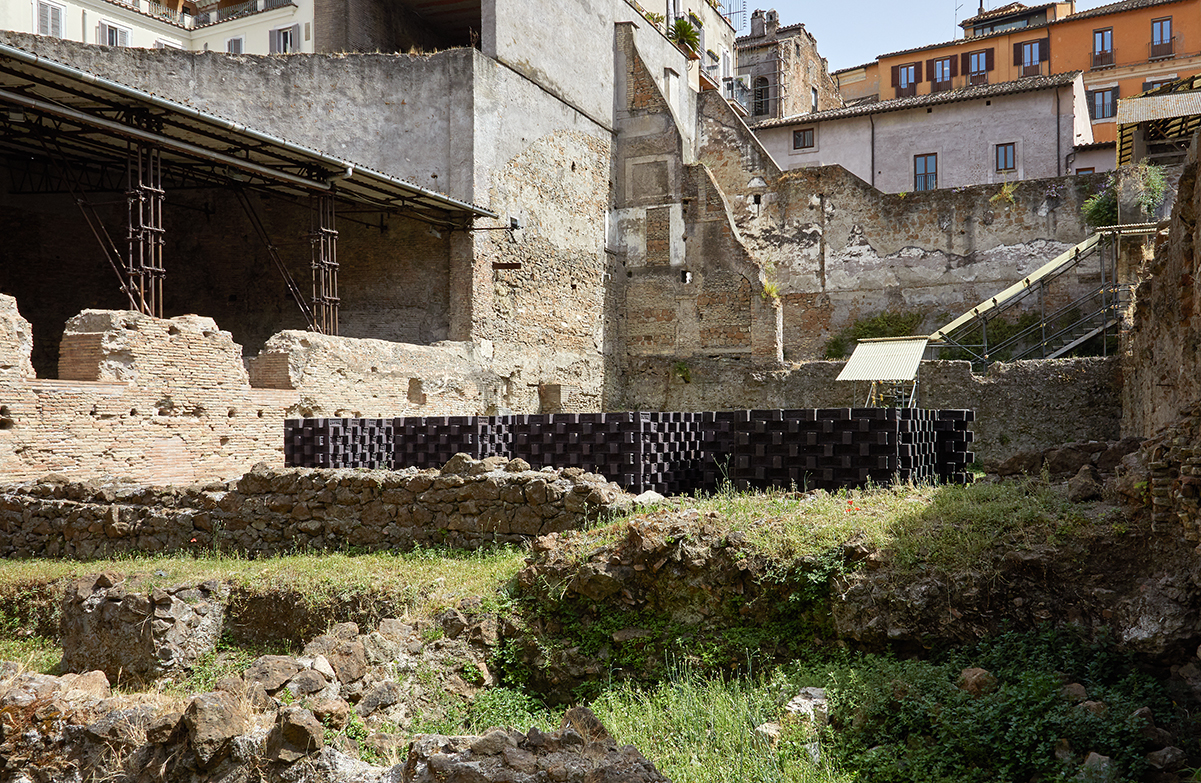
Crypta Balbi Museo Nazionale Romano, Rome
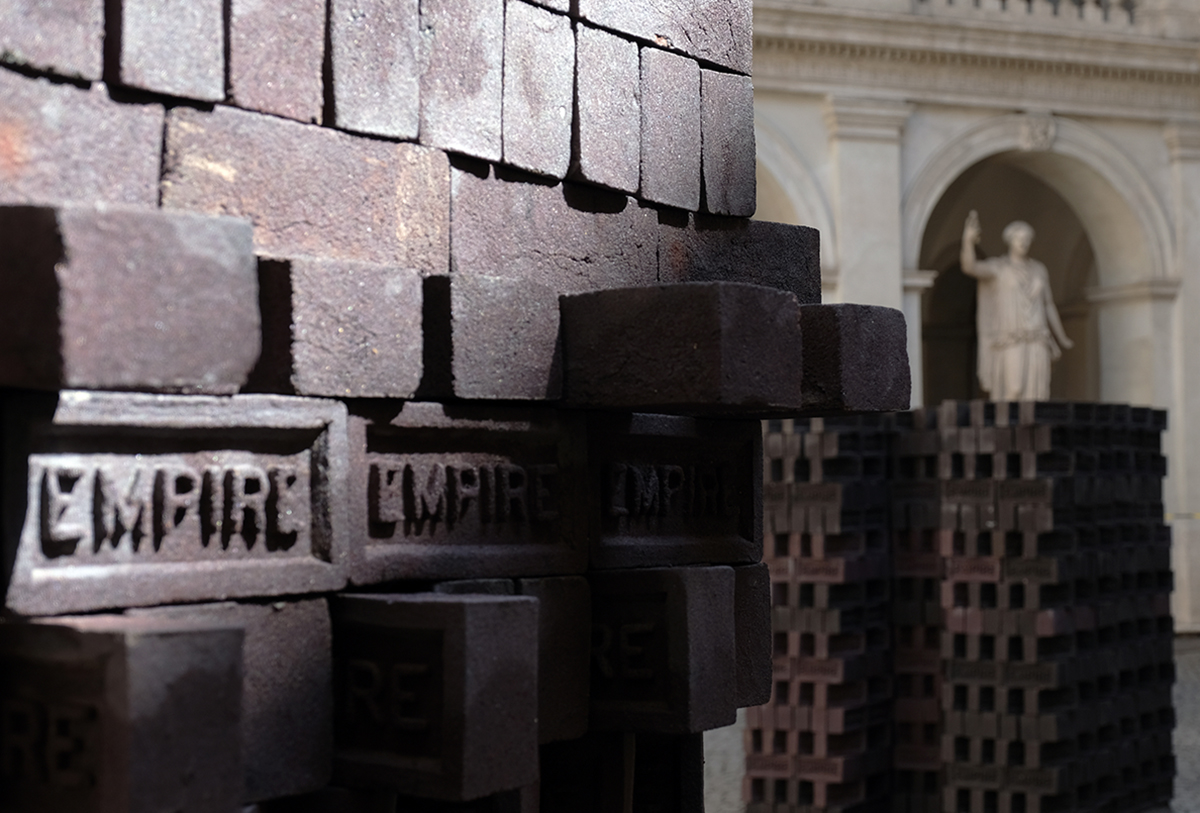
“EMPIRE is a purplish-black brick. EMPIRE is 6,000 purplish-black bricks. It is a wall, it is a solid volume, it is a hollow shell. It is a machine, a sculpture, a fortress, a ruin, a barrier. EMPIRE is the force that contains, and the mass being contained. EMPIRE is a myth, an inscription, a presence, a memory, a route, the destiny, an enemy, an anathema, an idea. EMPIRE is blind pressure, material weight, conquest, hegemony, obsession, stability, power. EMPIRE EMPIRE EMPIRE.
Let us start with its constituent elements, the EMPIRE bricks (the trademark of a long-defunct American brick manufacturer); in 1986, Carl Andre stacked eight of these precariously on top of each other for Manifest Destiny, a work created for a New York exhibition that raised funds for a historic American pacifist organisation, the War Resisters League.
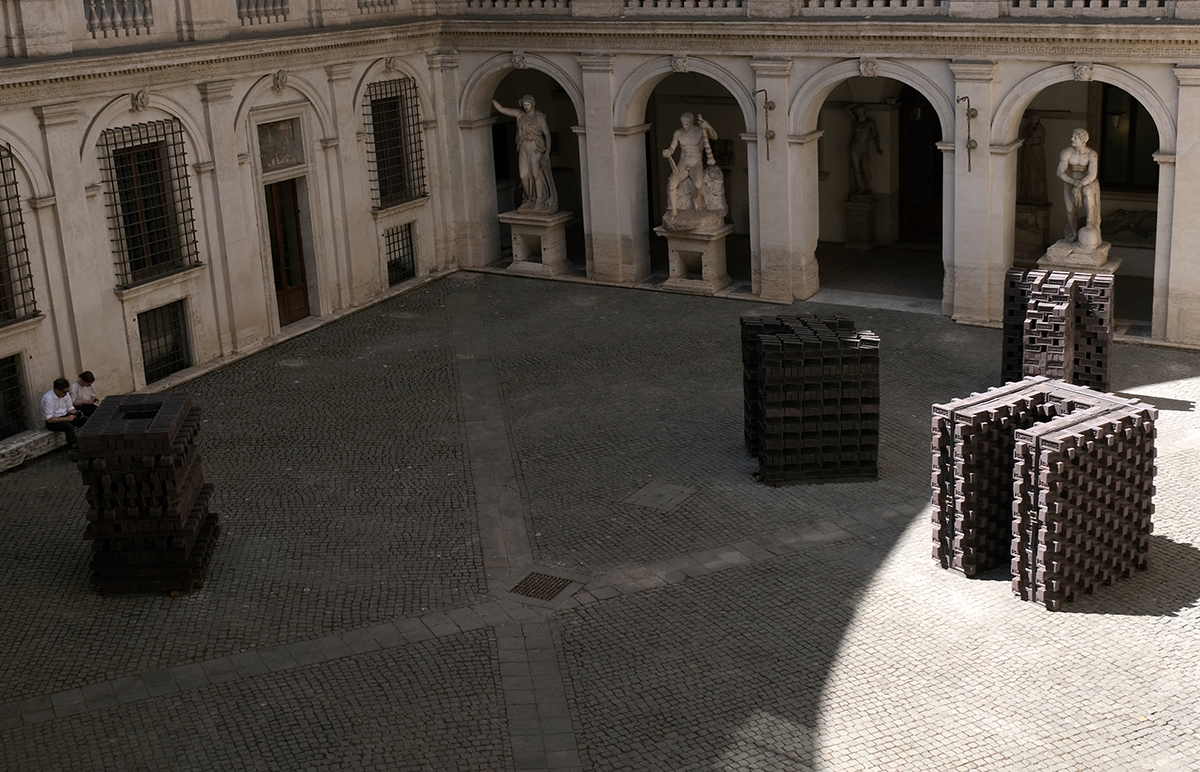
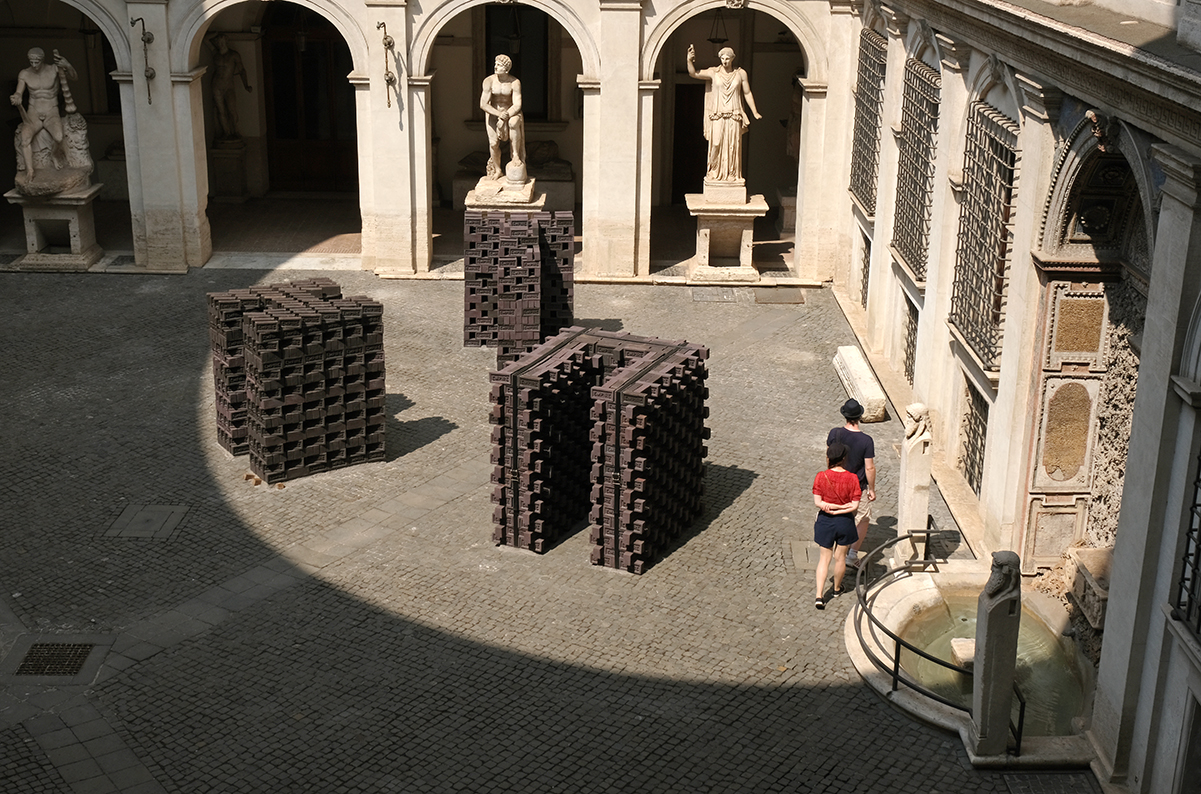
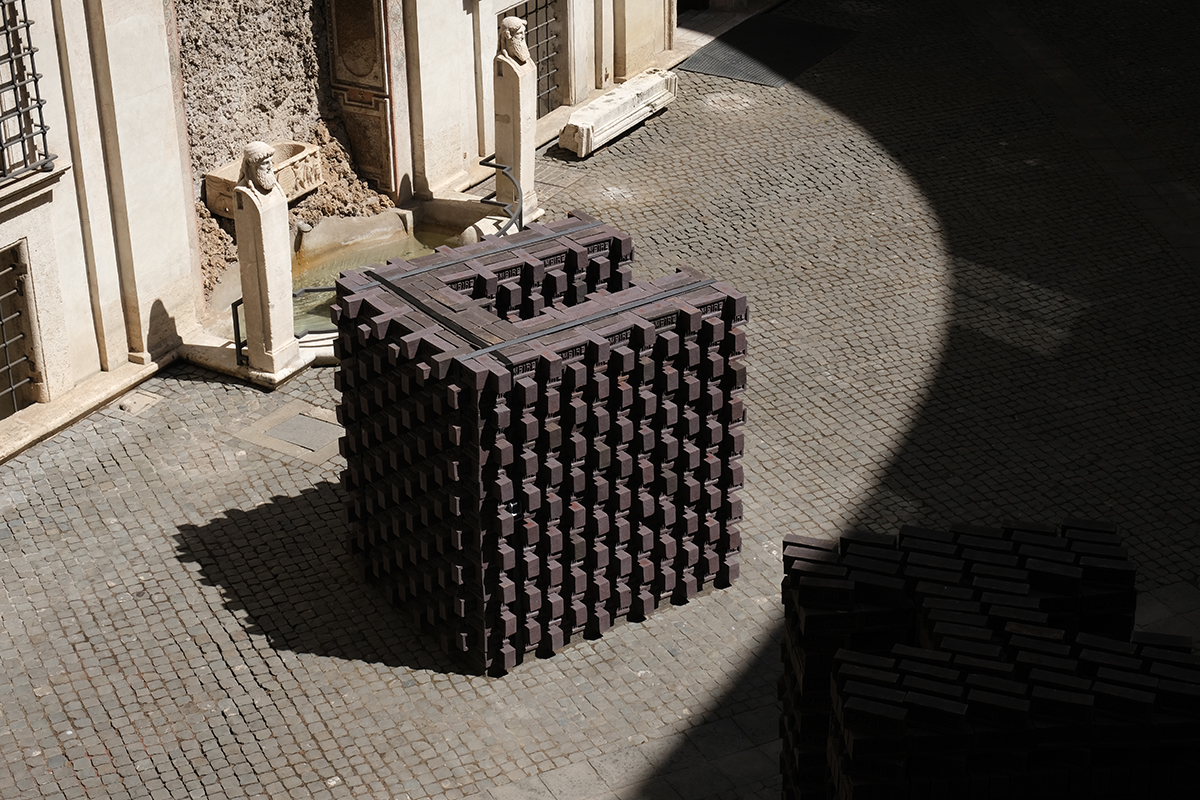
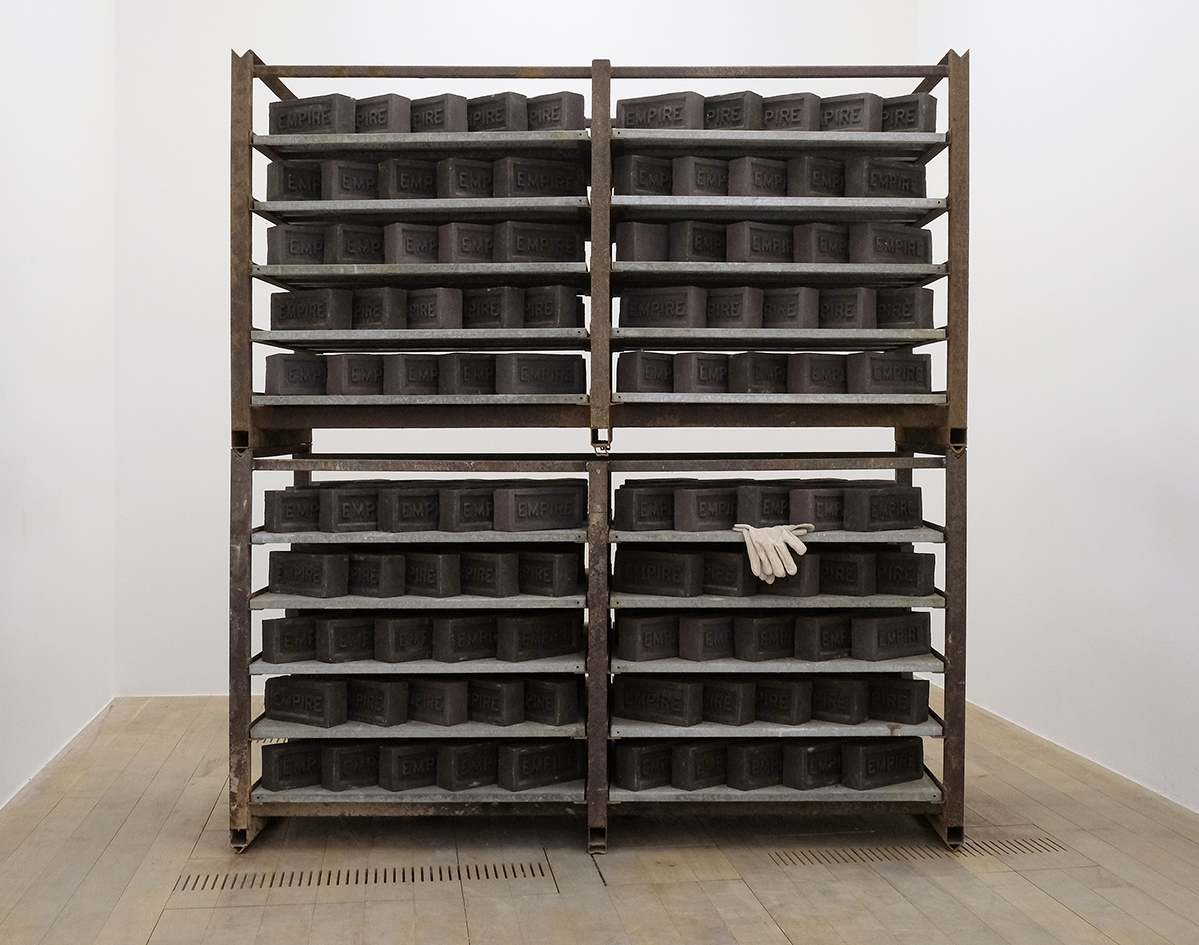
Elisabetta Benassi imagined Empire like a rhizome; something that evolves, that imposes itself on its environment. Some thing that can be complex or elementary, depending on the occasion: a labyrinth outlined on the floor (Italian Cultural Institute, London); four large three-dimensional structures (Palazzo Altemps, Rome); two metallic racks (MOSTYN, Llandudno); and a site-specific installation (Crypta Balbi, Rome). All are based upon a single component: a brick measuring 11.5 x 25 x 8 cm, produced by the Coleford Brick & Tile company in Cinderford, Gloucestershire, using traditional processes and materials; one of its sides is embossed with the trademark EMPIRE in uppercase letters. This module, which is as peremptory as it is enigmatic, undergoes a series of modifications. The result is clear to see, but the inner logic of those modifications remains obscure. For example, in the courtyard of Palazzo Altemps, we recognise the four forms as being the outlines of large three-dimensional letters – an H, a C, a T, and an O, about 2 metres tall and 1 ½ metres wide – but their choice nevertheless seems arbitrary, inconclusive. There seems to be no rationale, no relationship or parameter to confirm, no acronym to unravel. What we face is certainly the obvious result of a project, but neither its rough phenomenical appearance nor its evident combinatorial fervour provide sufficient clues as to the reasoning behind it. EMPIRE, as a hybrid object (visual-spatial-verbal), could then signify – with the sheer power of a name that has become an expansive structure – the energy of the unstoppable capitalist empire and, at the same time, its fractured uniformity. Or it could represent a critique of it, through the remarkable fusion of a historically overloaded concept with an image that reveals its protean nature. Above all, however, EMPIRE renders unfeasible a political and especially moral orthodoxy; a bien-pensant attitude that, for many, now seems art’s last chance in the age of its extreme reification. There is no trace, in Elisabetta Benassi’s work, of messages, nor evidence of identity thinking, moral certainties, or “blame”. The hard, abrasive surface of its individual bricks is not composed or elevated into becoming a structure, a wall, a construction; it is not redeemed by the powerful, perhaps inevitable symbolism of dwelling. Likewise, the theme of the work, with its social and economic references evoked by the process by which EMPIRE is produced and hand-assembled, is not reclaimed in a political or historical sense. It stays in the background, like a piece of information, rather than (to use a popular phrase) “generating awareness”. Upon closer examination of the forms arranged in the courtyard of Palazzo Altemps, we see that, despite their apparent solidity, everything hangs together in a precarious equilibrium: the rows of bricks, without mortar, are simply placed on top of each other. Overall, the structure relies on itself to bear only its own weight and the effect of the force of friction. Returning to Spinoza’s famous metaphor, however, the bricks are not – although they might believe they are – “free” to fall down. We are confronted with inflexible yet ephemeral structures; construction materials piled upon pallets waiting to be used (waiting to rebuild the Empire?). Ultimately, the propelling nucleus of EMPIRE could perhaps be exactly this motionless dialectic between materiality and project; between temporary and lasting; between incoherency and cohesion; between abstract, packaged, dehumanised labour, and workì as an ethical dimension and a factor for collective change, as Marxism saw it. But wouldn’t that still mean allowing spectators the option of an easy, virtuous, morally viable conclusion? What position does Benassi’s work really take, if not that of forcing the viewer to not expect any confirmation of that which is already known? I would suggest that what is far more important in EMPIRE is the reciprocal, irresolvable contrast between these polarised pairs; a contrast that is conflated with its mechanomorphic oddness, its slightly sinister appearance, and the palimpsest of references that complicate our reading of it. Elisabetta’s evocation of such a loaded, uncomfortable historical concept – the EMPIRE of the title – without providing any theoretical or ideological framework, is indicative of the methods she has deployed over the past two decades, and a precise clue to the register in which this work must be placed – namely, irony. An irony of proportion and situation, one might say: placing EMPIRE, a mobile and polymorphous work of art, in a dark hypogeum of defunct imperial Rome is a gesture that is explicit, impudent even. It cannot be explained away using the ecumenical-consolatory arguments typically used for contemporary art that references the ancient world. In order to take the empire seriously, its hideousness and greatness, we must strip it bare of erudite incrustations, of the stench of mould; we need to scrutinise its dark heart and above all to betray it, escape it, trick it. Irony here plays a complex and essential role: it serves to contradict the overly linear path of associations; to make life difficult for optimistic explanations; to disrupt hierarchies; to reintroduce dialectics into a field that can, apparently, manage without. Above all, it serves to perceive, if vaguely, the Nothingness behind every imperialist utopia, and behind any subversive and revolutionary utopia which believes it can combat the Empire – the Empire of Nothingness. EMPIRE, then, can be thought of as a conversion device, in which anomalous signifiers and materials are shifted and “translated” from one medium or semantic field to another, and from the phenomenological sphere to the cognitive sphere; this is done in such a way that the shift and subsequent re-assembly always produces an accident, an unforeseen lag. This process acts on several levels simultaneously, and also includes a latent, tendentious rewriting of the relationship with artworks and artists from previous generations”.
Stefano Chiodi’s text extracted from “Il senso della vita per la storia/The meaning of life for history”, in Elisabetta Benassi, EMPIRE, exhibition catalogue. Rome: Treccani, 2022, 18-37.


